Turbocharged systems expose hoses to heat, pressure changes, and engine movement. Choosing the right hose therefore involves more than checking its size or temperature rating. This guide explains what to consider when selecting a silicone turbo hose for a specific application.
Key Takeaways
- A Silicone Turbo Hose provides a flexible connection between components in a turbocharged air system.
- Selection should consider temperature, pressure, movement, and installation conditions.
- Reinforcement affects hose strength, flexibility, and dimensional stability.
- Silicone and rubber have different characteristics, so material selection should match the application.
What Is a Silicone Turbo Hose?
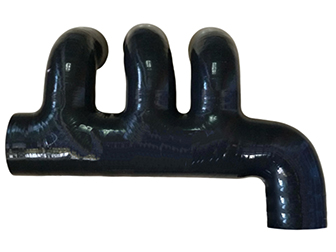
A Silicone Turbo Hose is a flexible hose used to connect components in turbocharged air systems. Depending on the system design, it may be used around the turbocharger, intercooler, intake, or charge-air piping. A silicone turbo inlet hose, for example, may be used on the intake side of a turbocharger.
Unlike rigid metal or plastic pipes, a flexible hose can accommodate small movements between connected components. This is important in an engine compartment, where components can move relative to each other during operation.
The hose also needs to maintain its shape and connection under changing conditions. RAINBOW's current product range includes turbocharger and supercharger hoses as well as hoses used for intercooler and intake piping.
Why Does Silicone Turbo Hose Selection Matter?
The main issue is not simply whether a hose can tolerate a high temperature. Turbocharged applications can expose the connection to repeated changes in temperature, pressure, and mechanical movement.
Temperature Cycling
A hose may repeatedly heat up during operation and cool down after the engine stops. This thermal cycling is different from exposure to a single maximum temperature.
For buyers, the relevant specifications should therefore distinguish between continuous operating temperature and short-term peak conditions. The actual temperature at the hose location should also be considered, rather than relying only on the temperature of the engine or turbocharger itself.
Pressure Changes
Turbo and charge-air systems can experience changing internal pressure during acceleration, load changes, and different operating conditions.
Hose construction and reinforcement influence how the hose behaves under pressure. A suitable design should control excessive expansion while retaining enough flexibility for installation and movement.
Vibration and Engine Movement
Engine components do not remain completely stationary. Vibration and relative movement can place repeated mechanical stress on flexible connections.
A hose therefore needs to accommodate the expected movement without becoming excessively stretched, compressed, or sharply bent. In some applications, specialized hose geometries such as hump sections can help accommodate movement and thermal expansion.
Installation Constraints
Available space can be just as important as material selection. A hose may need to follow a particular routing path, connect components at an angle, or fit around other engine components.
For this reason, the required inside diameter, outside diameter, length, bend angle, connection dimensions, and available clearance should be considered together.
How Does Silicone Turbo Hose Construction Affect Performance?
The performance of a hose depends not only on the silicone material but also on how the hose is constructed.
Inner Silicone Layer
The inner layer is directly exposed to the air or other media passing through the hose. Its formulation and thickness should be suitable for the expected temperature and operating environment.
For specialized applications, the inner layer may also require additional compatibility with particular media.
Reinforcement
Reinforcement is used to improve the hose's ability to handle pressure and maintain dimensional stability.
Different reinforcement materials and constructions can provide different balances between strength and flexibility. The appropriate design depends on the working pressure, hose geometry, bend requirements, and expected movement.
Outer Layer
The outer layer is exposed to the surrounding engine environment. Depending on the installation, this can include heat, ozone, moisture, dust, chemicals, and mechanical contact.
A suitable outer construction helps protect the hose during service.
Silicone vs Rubber Turbo Hose: What Should Buyers Consider?
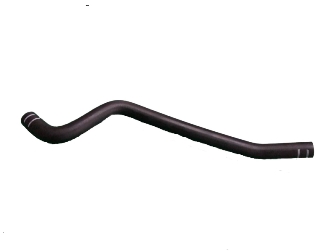
The choice between silicone and rubber should be based on the actual application rather than assuming that one material is always better.
Consideration Silicone Rubber
| Temperature performance | Generally suitable for demanding temperature environments, depending on formulation and construction | Depends strongly on rubber type |
| Flexibility | Good flexibility over a broad temperature range | Varies by rubber compound |
| Ozone and weather exposure | Varies by rubber type | |
| Oil and fuel compatibility | Depends on formulation; specialized lining may be required | Depends on rubber compound |
| Pressure performance | Strongly affected by reinforcement and construction | Also depends on compound and construction |
| Cost | Can be higher for some applications | Often competitive for general applications |
The key point is that silicone vs rubber turbo hose is not simply a material comparison. Buyers should consider temperature, media compatibility, pressure, movement, installation conditions, service life requirements, and cost together.
What Should B2B Buyers Check Before Ordering?
Before requesting a quotation, buyers should prepare as much application information as possible. Useful specifications include:
- Inside diameter and outside diameter
- Overall length
- Straight or formed geometry
- Bend angle and required routing
- Connection dimensions
- Continuous and peak operating temperatures
- Working pressure and pressure fluctuations
- Media carried through the hose
- Nearby heat sources and environmental conditions
- Required quantity and application
A capable Silicone Turbo Hose supplier should be able to evaluate these requirements together rather than selecting a hose by diameter alone.
For custom applications, RAINBOW can work from drawings, samples, or application requirements to discuss the required hose dimensions and construction.
FAQ
How to expand silicone turbo hose?
For installation, a silicone turbo hose should not be forced over a fitting that is significantly larger than its designed connection size. Use the correct hose size or a suitable reducer where needed.
How to cut silicone turbo hose?
Use a sharp cutting tool and make a clean, straight cut. Support the hose while cutting to prevent deformation. After cutting, inspect the edge and reinforcement before installation.
What temperature range can silicone turbo hose operate at?
The operating range varies by silicone compound, reinforcement, construction, and application. Check the manufacturer's specification for the specific hose rather than using a general temperature range.